Free travel all day for Disabled Pass holders

In another policy statement on buses, Andy Burnham’s government has announced that the restrictions on the use of concessionary bus passes issued to disabled people are being lifted.

A government spokesman said:

Eligible disabled people across England will get free bus travel all day, every day, after the Prime Minister announced today (Tuesday 18 August) that the government will lift time restrictions on concessionary passes.  

From 1 April 2027, people who hold a disabled bus pass can travel on buses for free, no matter the time of day. This extra support will help to open up access to workplaces, education, training, and other opportunities as well as giving people breathing space on the cost of living and putting money back in people’s pockets.

Currently, disabled bus passes are only valid for travel between 9.30am and 11pm during weekdays, unless local authorities choose to fund an extension. For example, Greater Manchester Combined Authority permanently lifted the time restrictions from March this year.

Backed by £60 million of funding, the Government is now stepping in to remove these time restrictions across the whole of England, so that from next year, disabled bus pass holders can always travel for free on the most popular form of public transport, regardless of their postcode.”

The change is the latest development to affect disabled pass holders in Lancashire. Prior to December 2018, pass holders could travel before 0930 on payment of a flat fae of 50p. In December 2018, citing budget pressures, this was raised to £1, which applied until April 2025 when the facility was abolished altogether and pass holders couldn’t use their pass until 0930hrs.

Anomalies?

Although the headlines surrounding the announcement stress the ability to travel free in the morning peak, the small print makes it clear that the evening travel restriction is alo being lifted. This leads to the seemingly annomalous position that holders of Disabled passes can travel after 23.00hrs but holders of Senior Citizens’ cards have to pay full fare.

Time for a review?

Whilst there are good grounds for allowing disabled passholders to travel free in the morning peak and whilst there is a need to prevent overloading of busy buses taking people to work and school by passengers riding for nothing, the Bus Users’ Group feels that it is time the 0930 start time was at least reviewed. Outside London and a few larger cities, the peak demand for bus travel is by schoolchildren rather than workers and most children are in school well before 0900. Bringing the start time forward by half-an-hour would give greater flexibility to pass holders and, by spreading journey start times over a longer period, reduce the pressure from passholders on the first bus that comes along after half-past-nine.

Evenings

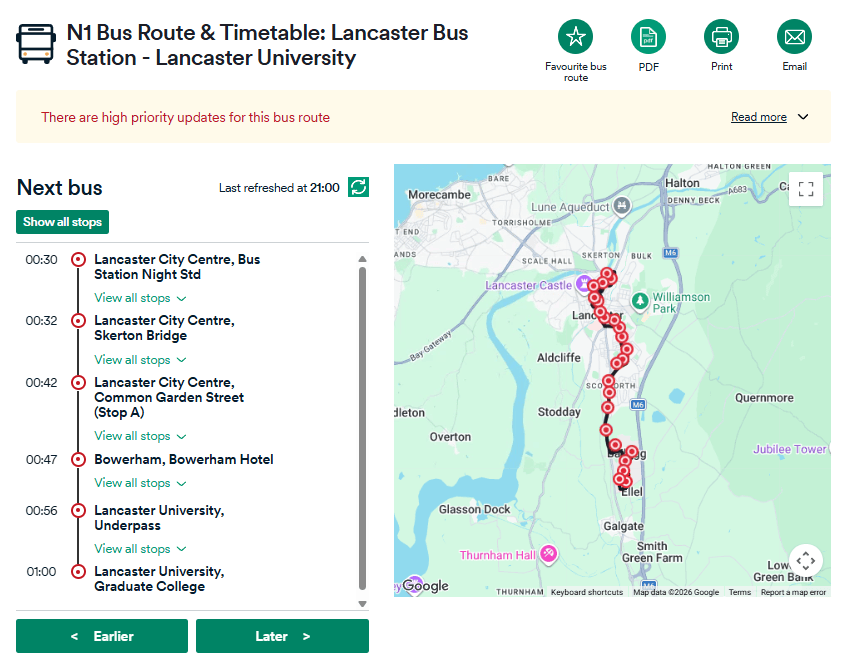
At present, bus passes cannot be used after 2300 hrs on Monday to Friday nights. The Bus Users’ Group has never seen a credible justification for this other than that it is “national policy”. Lancaster has a better late evening bus service than many places its size with buses running after 2300 to Morecambe, Bare, Heysham, Galgate, Garstang, Bowerham and the University. Despite being well used, they are rarely full and certainly have room for a few passholding pensioners who, contrary to belief, do enjoy an occasional night out! That the restriction was never thought through is clear in that it doesn’t apply on Saturday nights, or after midnight on Fridays, the two busiest nights of the week!

From 1st April 2027 these late night buses will be free for holders of disabled passes, and whilst senior citizens will not begrudge them this “perk” they will be wondering just why it doesn’t apply to them too.

Stagecoach changes its timetables

Stagecoach has changed the way it publishes its printed timetables for Lancaster and Morecambe, bringing them into line with other parts of the network. A new 69-page booklet, in a similar style to the popular “Lakes by Bus” publication, includes (almost) every Lancaster and Morecambe-based service and replaces a whole series of individual service leaflets.

Design

The Guide contains a network map, unfortunately not to the same high cartograpic standard as that in the Lakes Guide, but nevetheless adequate; a list of the bus services contained and a three-stage “How to Catch the Bus” section. Presumably aimed at those new to bus travel, or considering in for the first time, this takes readers through the process of planning a journey and buying a ticket. The third stage, however, entitled “Go”, advises passengers to “Wave the bus down and enjoy the journey”. New users – or those from other parts of the world where bus travel is less formal – could be forgiven for not realising that the “waving down” has to be done at a recognised bus stop!

Also included are some ideas for days out on the bus to local attractions and details (but not prices) of tickets. (A QR code link is provided for these).

Timetables

The timetables themselves follow the standard Stagecoach pattern in a clear and easy-to-read format, although those with poor colour vision might struggle to understand the purpose of the various shadings applied to some journeys. One fault concerns services 1/1A, 4 and 100 that serve Lancaster University and have significantly different service levels in term time and holidays. Both levels of service are shown, but unlike some previous leaflets there is no information on when “term time” and “holidays” actually are. Instead, passengers are asked: “For Lancaster University term dates, please check their website”(sic). It wouldn’t have been difficult to provide an actualwebsite adress, the Bus Users’ Group can do it on our website after all. In practice, there is plenty of room in the booklet to provide the actual dates for the whole of the forthcoming academic year and these are known well in advance.

Only Stagecoach services are included as the “Enhanced Partnership of Operators and Councils” doesn’t appear to extend to comprehensive timetables yet. On the two services where Stagecoach provides part of the timetable and Lonsdale Buses the remainder – the 18 and 81 – only Stagecoach journeys are shown and passengers are just informed that the other operator provides the rest, again with no website address or other means of establishing the full timetable.

Unfortunately, unlike recent leaflets, it appears that there is no room for the Bus Users’ Group logo in the new publucation.

Dates of Operation

The cover carries the apparently arbitrary date of 1st August (no timetables actually changed on this date), although the timetable for service 55 doesn’t apply until 30th August, when minor changes will be introduced. Unlike the Lakes Guide, there is no end date to validity. This is a common problem with bus timetables and produces unceratinty over accuracy as time goes on. The Group hopes that Stagecoach will resist the temptation to make minor changes, or at least to save them up and combine them with sufficiently large revsions that justify re-issuing the whole Guide. Better still would be to submit to the discipline of a published “until” date and delay any chnages until then, so that passengers know where they stand. This has been practice in the Lakes Guide for several years and hasn’t prevented the introduction of additional services during the validity period.

Missing Links

The 555 and 755 timetables can only be found in the Lakes Guide

Two important services are missing from the Guide. The 555 Lancaster to Kendal and 755 Heysham to Bowness have only QR codes that enable suitably-equipped passenegrs to read the timetables on their smartphones. For print copies it is necessary to obtain a copy of the Lakes Guide.

Omitting these services saves just five pages of print (out of 69) and the current timetables for these services run until 1st November, by which time Stagecoach is more than lilely to want to make changes to Lancaster services anyway. The Group feels that they should be included.

The booklet is available from Lancaster Bus Station and it is promised that copies will also be available on the buses, although we have yet to see one.

Despite these minor “niggles” the Bus Users’ Group recognises and supports Stagecoach’s commitment to printed timetables and the fact that putting (almost) everything in one booklet makes it much easier for passengers to get the full picture of the services available to them. Who knows, it might even encorage people to make additional bus journeys to places that they didn’t even know they could get to!