
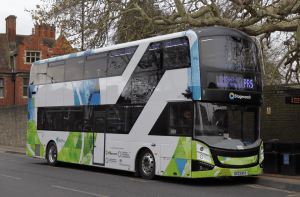
A fleet of 31 new battery-powered electric buses could be coming to Lancaster if a funding bid by Lancashire County Council is successful.
The County Council is seeking £15.75m from the government’s ZEBRA (Zero Emission Bus Regional Areas) Fund, set up under the National Bus Strategy of 2021 to help bus operators transition away from diesel-powered vehicles to cleaner and greener buses. The bid also includes provision for similar buses to convert some Stagecoach and Preston Bus services in and around Preston.
The new buses would be used on services 1/1A, 2X and 100 on the University – Lancaster – Morecambe – Battery -Heysham corridor. The bid is supported by Lancaster City Council as a contribution towards its aim to reduce air pollution in the city centre Air Quality Management Zone, where pollution levels are significantly higher than they ought to be. The grant would be passed on to the bus operators and would meet 75% of the difference between the price of an electric bus and its diesel equivalent. The balance of the cost will be met by the bus operators and the funding will also meet 75% of the cost of installing the necessary equipment to re-charge the buses at White Lund depot. None of the costs of either the buses or the charging infrastructure will fall upon the council.
The total available in what is the second round of ZEBRA funding is £129m, with at least 25% reserved for rural areas, for which Lancaster does not qualify. The council’s bid is therefore in the second priority group (out of three), which is “non-rural authorities that did not receive funding in the first round”.
Interest amongst local authorities has been higher than expected. Matthew Moll, Enhanced Partnership Manager for the County Council said: “Almost every Local Transport Authority in England seems to have submitted a bid to the ZEBRA fund, so there is going tobe a high level of competition. However, I feel that we have put in a good-quality bid”

Of course, the new electric buses would not be the first to grace the city’s streets. Lancaster Corporation Transport was an early pioneer in electrically-powered buses, with its first examples being put into service as long ago as 1916. It has to be said that these primitive vehicles were not a huge success, being unsuited to Lancaster’s hills and they spent most of their lives on the relatively flat Caton Road service. Nevertheless they lasted until 1929, which was just as long as many motor buses of the time.
A decision on the bid is due to be announced in March and buses funded under the scheme are expected to enter service no later than January next year.
 Lancaster Bus Users' Group