The results of the tendering process for local bus contracts to start on 26th October, recently published by Lancashire Council Council, reveal some changes to Lancaster area services. The council is required by law to seek fresh tenders for contracted bus services from time to time and as a result two local routes will see a change of operator later this year.
Service 18, the “East City Circular”, currently operated by Stagecoach, will be run by Lonsdale Buses on Monday to Saturday, although the Sunday service will remain with Stagecoach. The Bus Users’ Group has a particular interest in this service dating back to 2015, when Lonsdale, then trading as “Kirkby Lonsdale Coach Hire” reduced its commercial service over the route to just five journeys a day. The County Council at the time claimed that it had no money to pay for the full service to be continued, but the Bus Users’ Group, working with local city councillors, uncovered a fund of over £500,000 in “developer contributions” paid by the developers of new housing in the area that was intended to not only support the bus service, but actually to enhance it.
Members of the Group, together with Stagecoach managers and local councillors at the launch of the revived service 18 at Williamson Park in 2017
Mich of the funding had been diverted to other projects and it was only after a lengthy campaign, involving Lancaster City Councillor Tim Hamilton-Cox and County Councillors, Gina Dowding and Lizzi Collinge and with the help of Cat Smith MP that the County Council could be persuaded to put what money was left to the purpose for which it was intended. The contract for the revived service, which began in 2017, was awarded to Stagecoach, which has operated it successfully ever since.
Services 88 and 89 Lancaster to Knott End
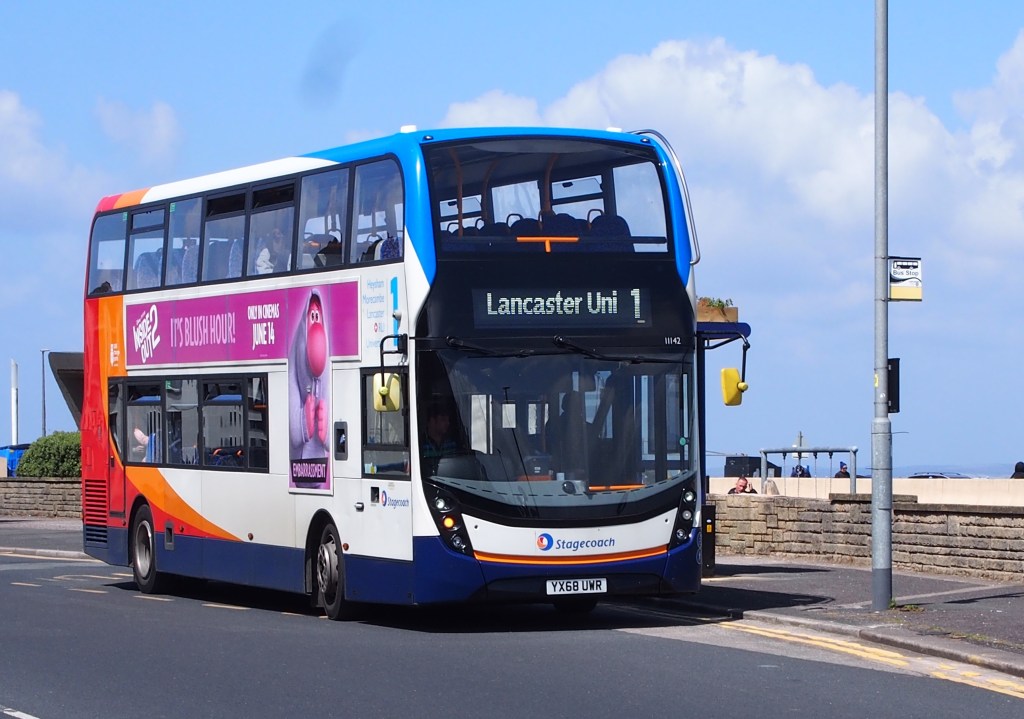
Stagecoach buses will return to Glasson Dock when the new contract starts in October
These services change hands in the opposite direction, with operation passing from Lonsdale Buses to Stagecoach. Co-incidentally, Lonsdale Buses (then Kirkby Lonsdale Coach Hire) took over the route from Stagecoach at about the same time as service 18 changed hands, although the “Stagecoach” involved was actually Stagecoach Merseyside and South Lancs, which ran the service from its Fleetwood depot. This time round the service will be run by Stagecoach Cumbria & North Lancs from its Morecambe depot.
Service 89 is the long-standing route between Lancaster and Knott End, with service 88 being added in 2023 using Bus Service Improvement Plan funding to provide a link to Garstang from the villages served.
Other services
The tendering exercise included new contracts for service 8 and 9 in Lancaster, service 51 between Carnforth and Silverdale, the evening service on the 81, and the Sunday services on the 7, 10, 11, 18, 81, and 82 although none of these contracts has changed hands.
Two services will be split between operators. Service 18 will be run by Stagecoach on Sunday and Lonsdale Buses the rest of the week, and Stagecoach will continue to provide the evening service on the 81 to supplement the daytime journeys run by Lonsdale Buses.
What does it all cost?
The county council is required to publish the results of the tendering process from which it is possible to gain an idea of how much money is required to sustain non-commercial bus routes in the county.
The annual value of the six contracts comes to just over £1,000,000, ranging from £37,000 for the Sunday service on the 7,10,11 and 18 to £588,000 for the Lancaster to Knott End service. The actual cost to the county council is lower than this, as in most cases all income accruing to the services from passengers’ fares and concessionary pass reimbursement is deducted. The Council also receives Bus Operators’ Support Grant for contract services from central government, which in 2025/6 totalled £1.87m for the whole county.
New timetables have brought confusion to the bus stop displays on the 1 1A and 100
Lancashire County Council deserves praise for the comprehensive provision of information at bus stops throughout its area. Most stops on main routes and many on minor services have displays containing lists of the departure times of buses and their destinations.
With several thousand bus stops to look after, it’s obvious that the council needs to use an automated system to produce the displays, but it’s a pity that the system chosen is inflexible and apparently not geared to tailoring the displays to local conditions. The system is also designed to produce extremely comprehensive information – some times too much so – and therefore falls foul of one of the golden rules of information provision – you can be comprehensive or comprehensible – but not both – and Lancashire errs on the side of comprehensiveness!
Service Revisions Cause Confusion
One feature of Lancaster’s bus services that does not apply throughout Lancashire is the timetable variations between University terms and holidays. In the holidays, service 1 from Heysham terminates at the Bus Station rather than the University and service 1A is similarly curtailed in the evenings and on Sundays. At the start of the current holiday period Stagecoach brought about further complication by a swop of routes within the campus that only applies during the holidays: service 100, which previously served the stops in the south of the campus including the Graduate College, is cut back to the central Underpass stop, whilst service 1A is extended in its place. In a classic example of the Law of Unintended Consequences the move has brought much complication – and hence confusion to the county council’s bus stop displays.
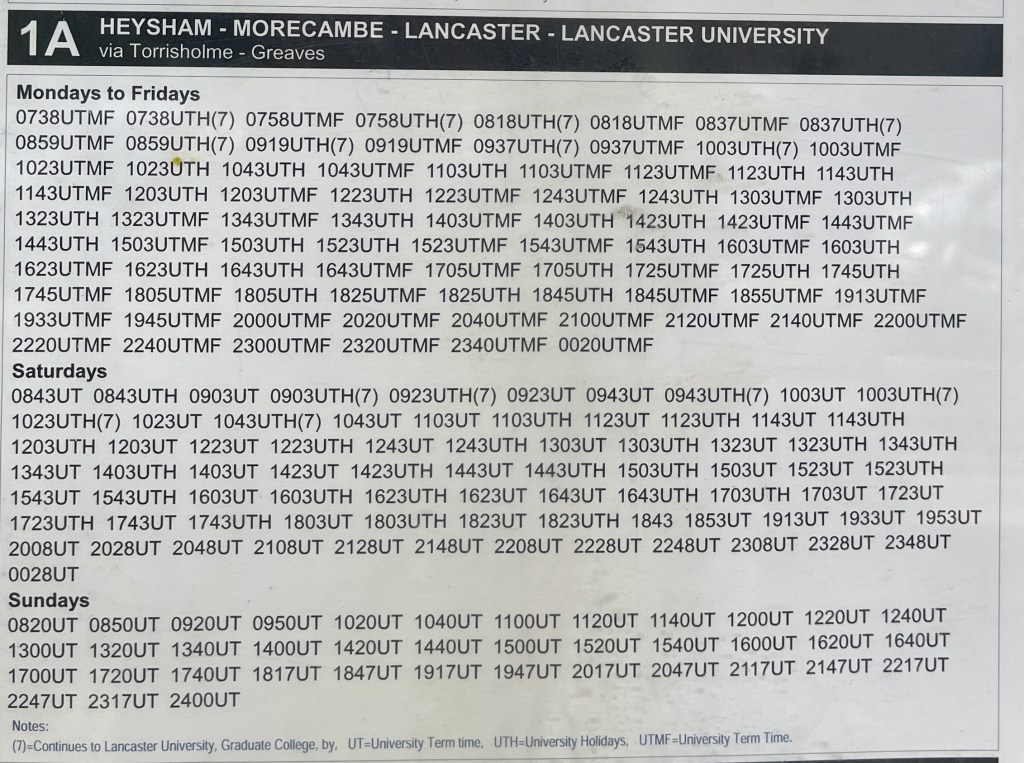
The following display is from the stop at the Infirmary, but similar ones will be found along the A6 or Bowerham Road towards the University. The first thing to notice is that the 1 and the 1A are treated as completely separate services. This is despite the fact that the difference between them is a route variation in Heysham. Between the bus station and the University they follow exactly the same route and to all intents and purposes they are one service, but one that requires passengers to consult two departure lists to see the full picture.
Service 1A
Let’s look at the 1A in more detail
The first thing to notice is that every journey comes with a qualification: On Mondays to Fridays this is either UTMF or UTH; on Saturdays and Sundays UT or UTH. The “Notes” explain that UT = University Term time; UTH = University Holidays and UTMF also means “University Term Time”! The “MF” part of this last code is not explained, but presumably means “Mondays to Fridays”, but quite why that is necessary for a departure list headed “Mondays to Fridays” is unclear. Also, if “UT” stands for “University Term time”, shouldn’t the code for University Holidays be “UH” – what does the “T” stand for here?
Journey Duplication
But are these qualifications necessary in the first place? Every departure is shown twice, one bus runs during term time and the other in the holidays – at exactly the same times! The BUG suspects that because the 1A follows different routes through the campus according to whether it is term time or not, the system treats it as two completely different services. The UTH departures have an additional code (7) which explains that the journey “continues to Lancaster University Graduate College”. But all service 1A buses run to “Lancaster University” and the system doesn’t feel it necessary to explain where on the campus the “UTHMF” journeys terminate. The system is being “comprehensive” but not “comprehensible”!
A simpler and more easily understandable display would merely list each departure time just once, with the 1 and 1A shown together and with no qualification other than a note somewhere to explain the different routings according to time of year.
Service 100
Turning now to the 100.
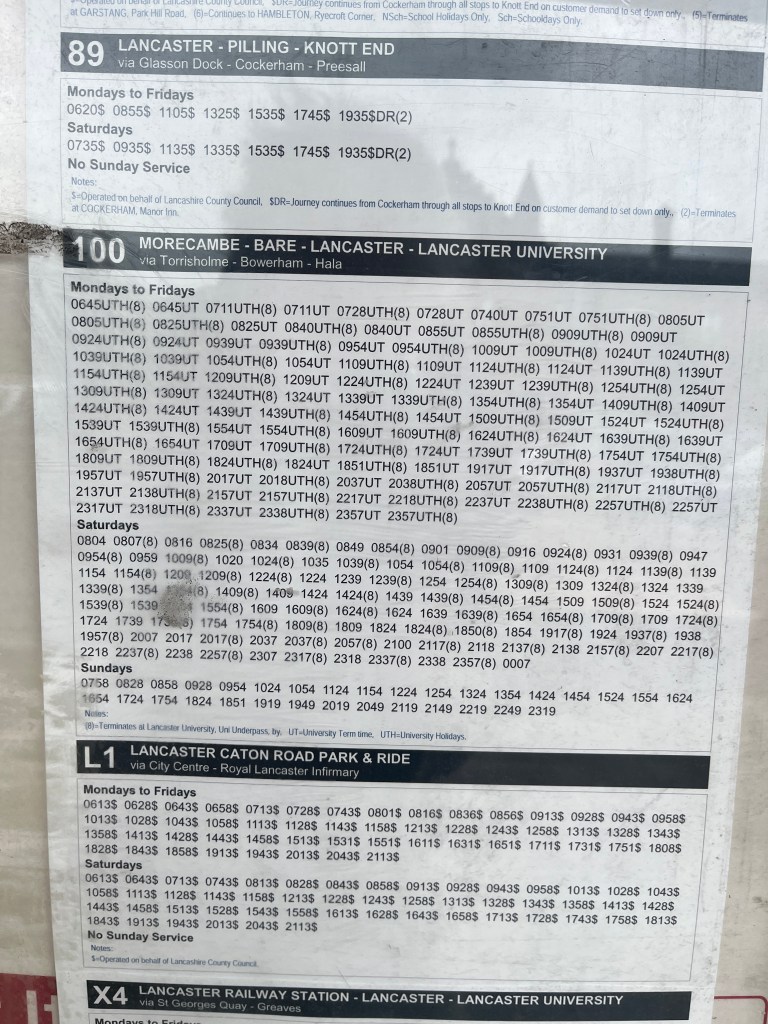
Once again, every journey is shown twice, but on Mondays to Fridays, unlike the 1A, the code UTMF is not used. Journeys are coded “UT- University Terms” or “UTH – University Holidays” Every UTH journey has an additional note: (8) explaining that it “terminates at Lancaster University, Underpass” although as the service header just describes the terminus as “Lancaster University” one wonders how many passengers understand the significance of the note.
Again for simplicity, if it is really necessary to say so, each journey could be shown just once, with a code to explain that “In University Holidays this journey terminates at the Underpass, not the Graduate College”
Rubbish In…..?
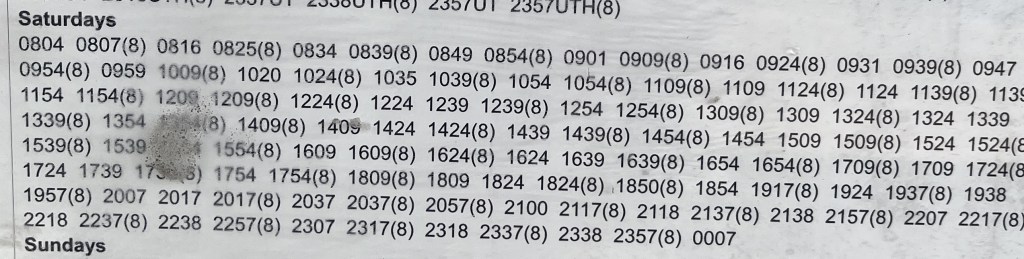
Any automated system is only as good as the data it is given to work with and unfortunately it is not just Stagecoach’s service changes that are causing confusion. Let’s have a look at the Saturday service on the 100 in more detail:
At first glance it appears to be a very frequent service, albeit with some departures very close to one another. The duplication between term times and holiday departures doesn’t help, but that is not all that is misleading.
Comparison with the public timetables issued by Stagecoach reveals the following:
The journeys shown at 0804 0816 0834 0849 0901 0916 0931 0947 0959 1020 and 1035 are not in the timetable and presumably do not exist!
Every journey between 1054 and 1824 and at 2017 and 2037 is shown twice – once to say that it terminates at the Underpass in Holidays and once with no qualification at all.
The journeys at 1854 1924 1938 2007 2100 2118 2138 2207 2218 2238 2307 2318 2338 and crucially, the “last bus” at 0007 are not in the timetable and presumably do not exist!
The nett result of there errors is that what appears to be a very generous service of 100 buses per Saturday is, in practice one of just 49 journeys with the last departure of the day operating ten minutes earlier than shown.
…and on the 1A
There is also a problem with the Saturday times on the 1A in the evenings. A departure is shown at 1843 which is the only one of the day NOT to be coded “UT” This does not correspond with the printed timetable booklet that shows it, along with all the others, as running Term Time only. More seriously, after 1933 the times shown do not correspond in any way with Stagecoach timetables, right up to the last bus which supposedly leaves at 0028, eight minutes after Stagecoach says it runs!
Service 1 as well
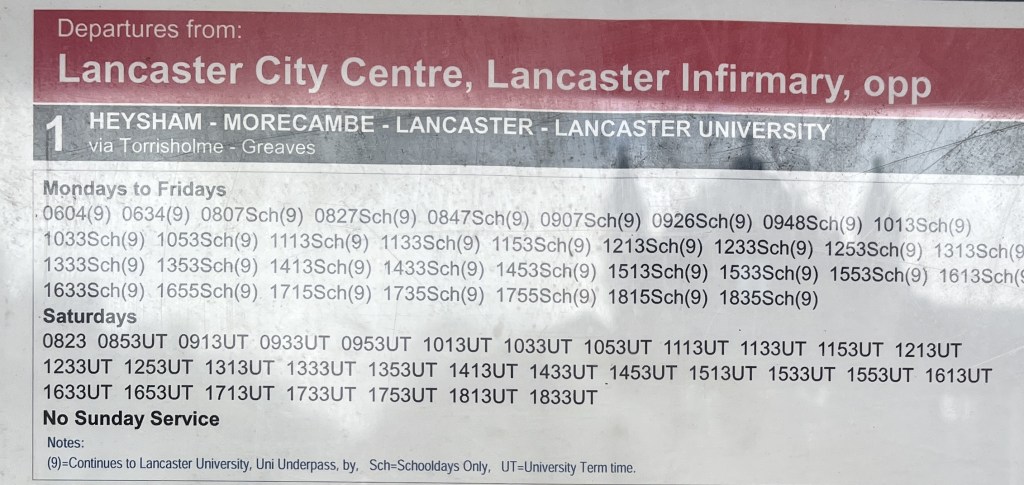
Service 1 only operates south of the city during University terms (“UT” or perhaps “UTMF”), but here’s what the bus stop displays show:
The service header shows it as running between “Heysham” and “Lancaster University”, which in term times is what it does. So why does every journey have a code (9) to say that it “Continues to Lancaster University, Uni Underpass, by.” “Continues to from where?!
More seriously, every journey is marked with “Sch” to mean “Schooldays only”. Lancaster residents may not know exactly when University terms begin and end (another problem with the displays) but they do know that they are different to school terms. Lancashire’s system does recognise that the Saturday service runs “UT” or “University Term Time” rather than “Schooldays”, presumably because it doesn’t expect Saturday to be a school day.
Pedantry…and the missing night bus
The 1A departure lists (see image above) include a journey on Monday to Friday at 0020 and on Saturday at 0028 (although this latter is incorrect). They are shown at the end of the operating day. But any time after midnight is, strictly speaking, part of the following day’s service, so the buses actually run on Tuesday to Sunday mornings! LBUG realises that this is being pedantic and that nobody who is capable of being out and about at that time of night is likely to misunderstand. But just when does the “day” change? Would a journey at 0100 be shown at the end of the day or the beginning; how about 0230 or 0345?
For the avoidance of doubt, we would suggest that such journeys be shown at both the end of the day and at the beginning of the next one. So the 0020 on “Saturday” would be shown at the end of the Saturday timetable as well as at the beginning of the Sunday one.
Following discussions with LBUG, Stagecoach now shows its N1 “Night Bus” service as operating “Early Hours Tuesday to Thursday” or “Early hours Friday to Sunday”
We feel this is a reasonable compromise that is correct enough to satisfy us pedants and at the same time is actually helpful to the travelling public.
We were interested to see how LCC treated this on its bus stop display at the Infirmary, but we can’t tell you, because the N1 is completely missing from the display.
Bus companies are unusual in relying on third parties, in this case Lancashire County Council, to maintain their “shop window” publicity. The BUG understands that they are required to make a contribution towards the costs incurred by the council but we wonder whether they ever check to see that they are getting their money’s worth.



 Lancaster Bus Users' Group