
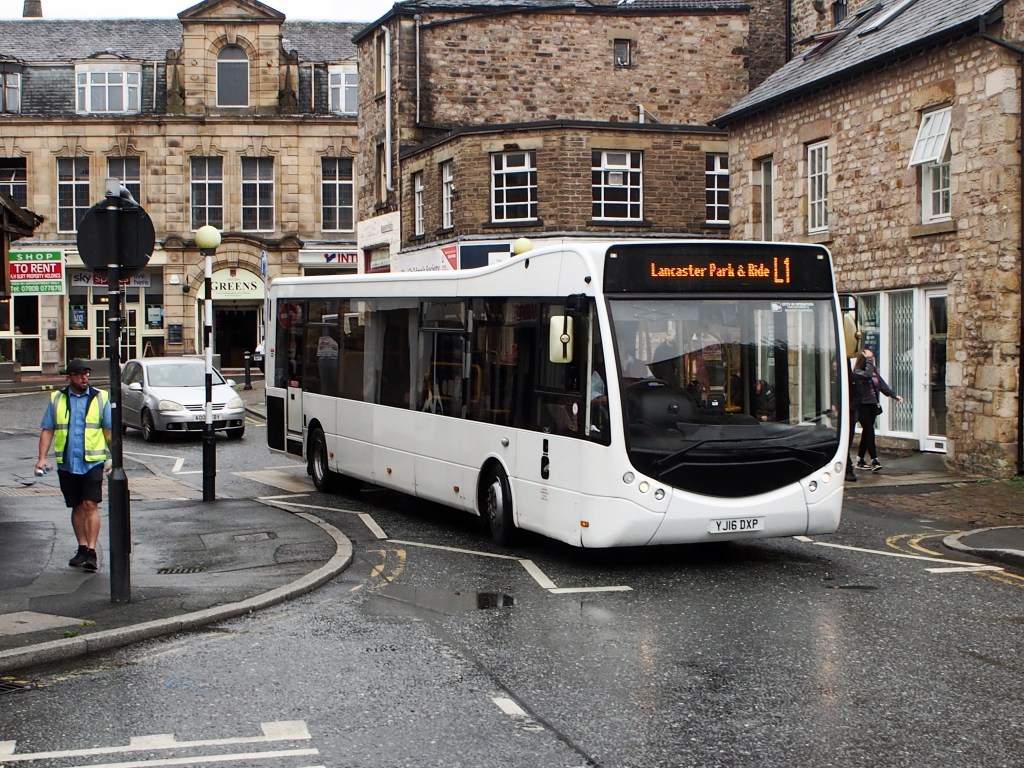
Lancashire County Council is proposing consulting the public on the future of Lancaster’s Park & Ride service, which links the car park at Junction 34 with the city centre and the Infirmary via Caton Road.
The service costs the council £780 per day (£238,000 per annum) but is used, on average, by only 150 passengers, meaning that each return passenger trip costs the council £5.20. Passengers pay just £2.50 return or nothing at all if they have a concessionary pass. Each of the 54 single trips between J34 and the Infirmary carries on average just 2.8 passengers.
Bay Gateway
The service was introduced in 2016, after the planning consent for construction of ther “Bay Gateway” (Heysham Link Road) required the provision of a dedicated car park at Jc 34 of the M6. However, no provision was made for funding to operate a bus service to the city centre. Presumably the planners assumed that bus operators would find it a commercial proposition, which they didn’t: unsurprisingly in view of the currrent figures.
Eventually, the county council came up with some money to provide a one-bus operation running every thirty minutes, this being at a time when other bus services, that people were already using, were being cut due to a lack of funding! Users of the Park & Ride do, by definition, have access to their own private transport, unlike many bus passengers.
Lack of Incentives?
There are many reasons why the service might not have reached the levels of useage needed to justify its continuance, all of which conspired to reduce the incentive for car drivers to use it. One of these was that car parking is not exactly difficult or expensive in Lancaster. Another was its low profile. At first, the service was operated by a vehicle in a dedicated promotional livery
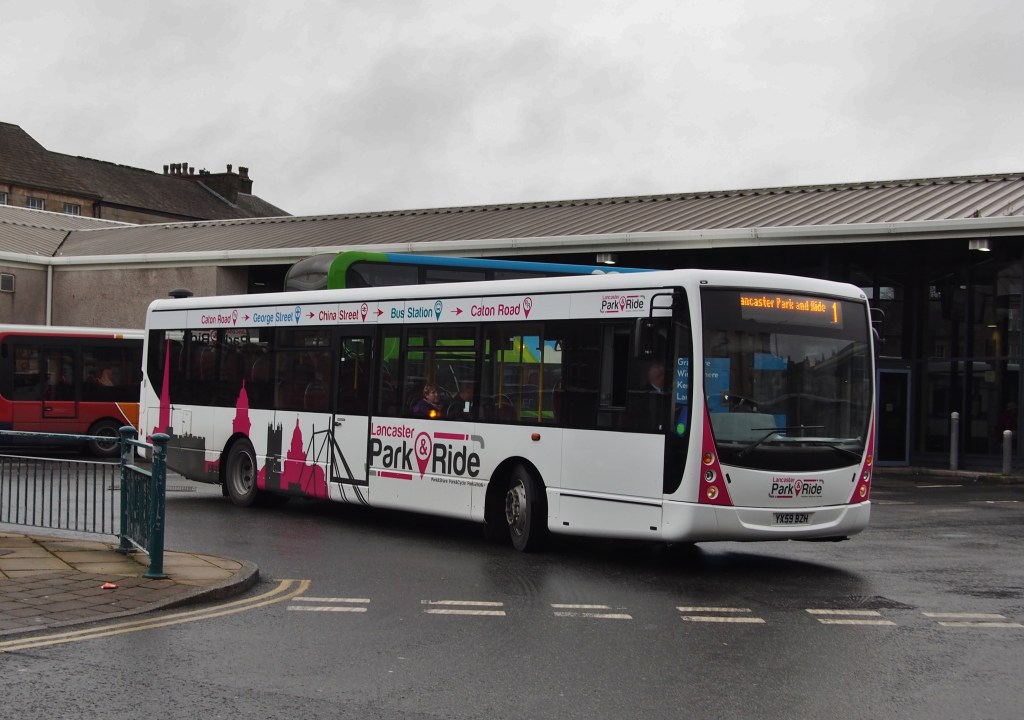
but this was later discontinued and the bus operator used whatever was available from its normal fleet. The low frequency did not help, as it meant that the service wasn’t particularly visible on the city’s roads. A promotional leaflet was produced, but distribution seemed to be limited to Lancaster library and then availability was sporadic.
Frequency
The frequency was low; buses ran only every half-hour, whilst in the peaks, when demand should have been greater, it was reduced to every 45 minutes, ironically because the bus needed more time to complete its journeys due to the traffic! For a couple of years from July 2021 an extra bus was employed to increase the service to every 15 minutes, but this had the side effect of making access to the city centre by passengers more difficult (see below).
Stops
The stops in the city centre were not very convenient. To begin with, coming from Caton Road, buses called at North Road (opposite Sainsbury’s), George Street, China Street and the Bus Station of which only George Street was within the gyratory and even that was at the extremity of the shopping area. When the service was increased in fequency it was also extended beyond the centre to the Royal Lancaster Infirmary (with funding from the NHS). This added a stop at the Infirmary, but removed the stop at George Street!
Then, in July this year, when the funding was withdrawn, the frequency reverted to every 30 to 45 minutes, whilst the extension to the Infirmary remained, giving the worst of both worlds for passengers trying to access the city centre.
Local Passengers
Caton Road and the adjacent Newton Estate are not well served by local buses compared to other areas of the city, so the Park & Ride could provide a useful facility for residents. At some stage, local passengers were being catered for and there is evidence that residents of Newton Estate were walking to Caton Road to use it. Later, however, the county council withdrew this facility and insisted that the service operate “non-stop”, relenting only to allow workers and others to use the stops at the Holiday Inn and Lancaster Business Park after a campaign by employers, staff and the Bus Users’ Group.
The Future?
Assuming the Council goes ahead with its “consultation” everyone will have a chance to have their say. As a Bus Users’ Group we are conscious that the majority of people likely to be affected by closure are car owners who will have the obvious and easy alternative of driving into the city (although those at the Infirmary will admittedly have difficluties parking). Very few “bus users” will be affected.
The car park site itself is to remain open, as the council also sees it as a “park and car-share” facility whereby several car drivers can meet up and use just one vehicle to access the city (or continue down the motorway to destinations farther afield), whilst plans for Morecambe’s Eden Project envisge a Park & Ride service from Caton Road to the Eden site.

