
-
Buses to the Quay: The wait goes on….
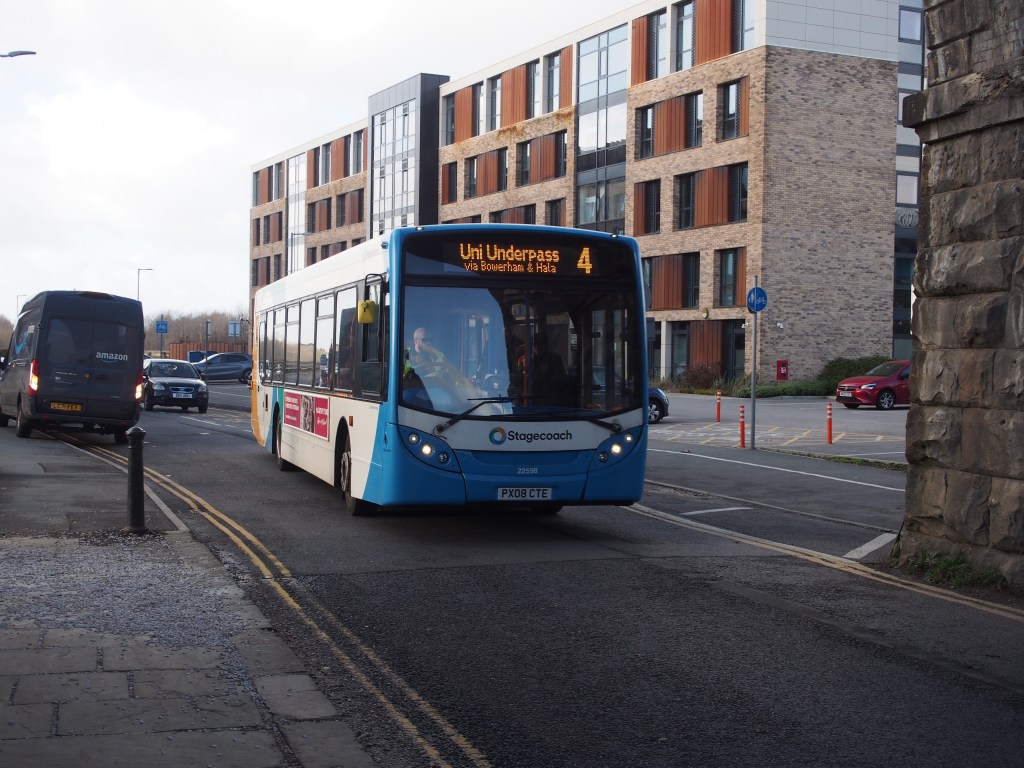
Stagecoach service 4 on the very short section of the Quay that does have a bus service Residents of the major housing developments that have taken place along the Quay in Lancaster face an even longer wait for their bus service.
Over the last ten years, almost 500 new homes have been built as part of the Luneside East and Luneside West development, built, sustainably, on the “brownfield” site that was once a major idustrial area. That sustainability, however, hasn’t extended to the provision of a bus service.
Houses but no buses
Despite the size of the development, neither of the city’s two bus companies saw a commercial opportunity, so a bus service was always going to need public fuding, at least until it could become established.
The larger of the schemes, the 403-home Luneside East, did require a contribution of £625,000 for “sustainable transport improvements” from its developers. At the time, the council’s preference was for a “bus-only” bridge across the Lune, which would have allowed buses to and from Morecambe to run via the Quay, but this was never built and it is not clear what else the money was ever spent on. The housing deveopment was taking place during a period when Lancashire County Council was seeking to solve one of its financial crises by reducing support for buses, so no funding was available from that source.
From 2021 government support for bus services was provided through Bus Service Improvement Plans and then Local Bus Grant allocations. Lancashire County Council has received very significant funding as a result, but despite requests from The Bus Users’ Group it has declined to spend any of it on a service to Luneside.
Luneside Business Park
Starting in 2022, there was a major development and expansion of the Luneside Business Park at the very western end of the New Quay. Finally, this was a develpment that did require a contribution towards a bus service, with developer Hurstwood Holdings having to make £500,000 available to fund one. But despite the work being substantially complete, there have still been hurdles to cross before a bus service could start.
Turning Circle
The powers-that-be determined that before a bus service could start, a bespoke bus turning cicle would have to be provided at the end of the route near Thetis Road.. There were lengthy delays, reportedly due to issues over land ownership, but the circle has now been built and, as can be seen, it is to a very high standard.
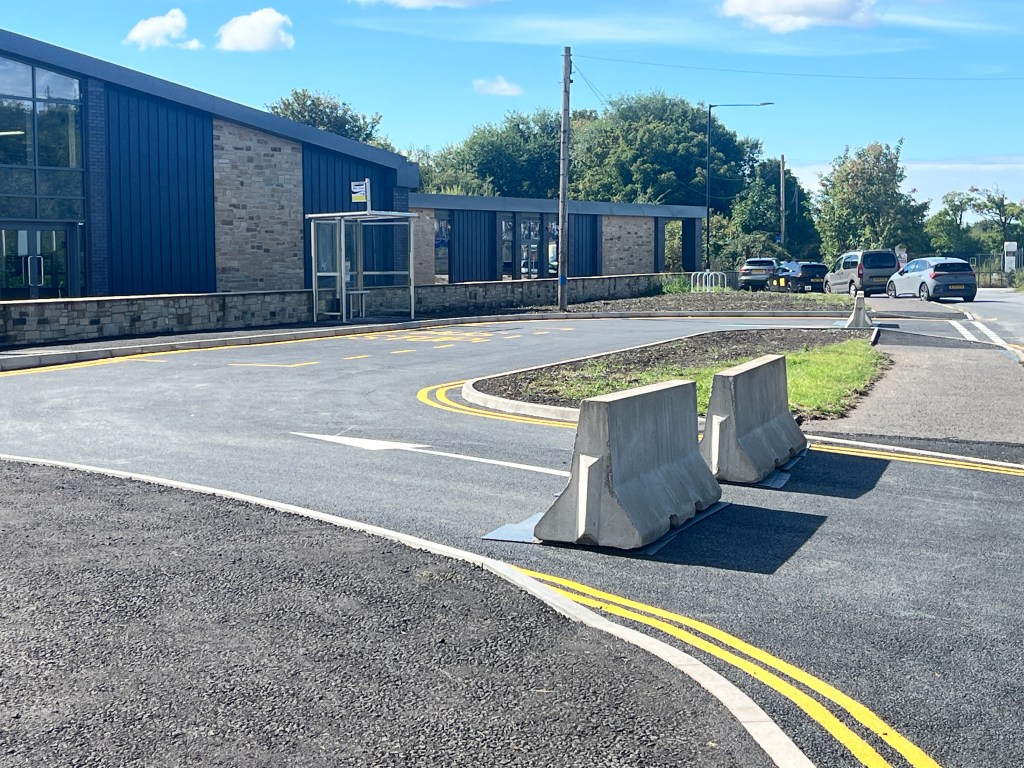
The new turning circle at the Lune Business Park Hopes that this had removed the final obstacle to providing a service have, however, proved premature. The Bus Users’ Group now understands that before the facility can be used it has to have street lighting installed. Whilst this has, reportedly, been commisioned there is, as yet, no date for completion.
Further Problems Ahead
Lancashire County Council’s public transport team is keen to see the service start. It has already entered into an agreement with a bus operator to provide a service six-days-a-week from early morning to late evening linking the Quay to the bus station and city centre, subject only to the developer funding being received.
This should be straightforward given that the development of the Business Park is complete, but there are now doubts. In early October, the developer Hurstwood Holdings (profits in 2025 £4.467m) submitted an application to the City Council for a “developer request for status of outstanding contribution amounts”. Its unclear what this somewhat technically-worded request actually means, but its doubtful that Hurstwood is seeking to pay a higher amount! It appears, therefore, that there is at least a question over how much of the £500,000 will actually be forthcoming and when it will be avalable.
Best Practice
Best practice on large-scale housing developments is that a bus service should be established at a very early stage, so that new residents can factor it in when developing travel patterns. A ten-year delay (at least) in provding a service makes it much harder for one to become established, as residents will have developed ways of doing without it (largely by driving everywhere) and will be reluctant to change.
At this time, despite the turning circle and an agreed timetable being in place, there is still no indication as to when a service will start.
-
Carnforth Closures Cause Confusion
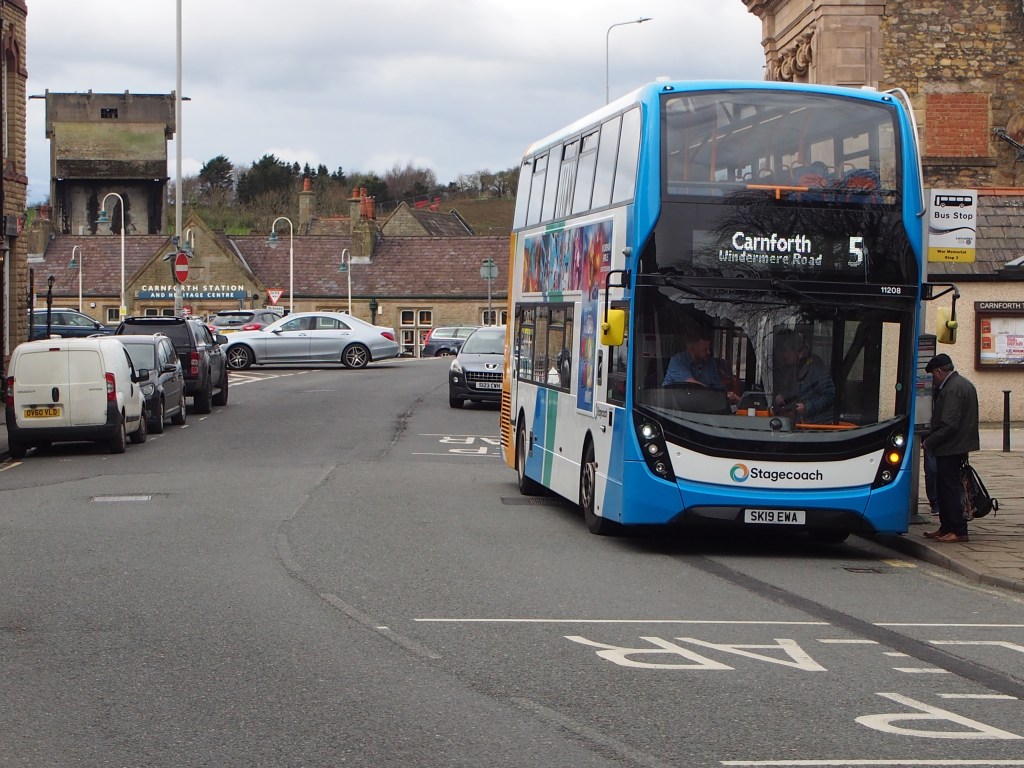
Road Closures and diversions in November are confusing residents UPDATE 11th November: We have been informed by Stagecoach that the road closure will NOT apply on Saturday or Sunday and that the buses will run as normal.
Road closures that necessitate bus service diversions have reportedly been confusing bus passengers in Bolton-le-Sands and Carnforth. Stagecoach staff have placed notices on the affected bus stops, but the message is complicated and difficult to get across on a single sheet of paper. The company’s website also explains the position, but in a slightly different way and, until the Bus Users’ Group pointed it out, neither mentioned the 555 -possibly Carnforth’s most important service! (This has been corrected on the website)
At the risk of further confusing the situation (we hope not!) here is our take on what will happen.
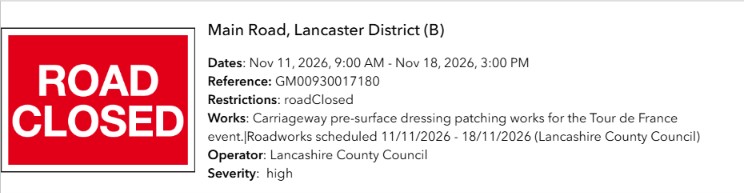
Lancashire County Council’s official closure notice The A6 will be CLOSED during the above dates and times between Bolton-le-Sands (Junction with the Coastal Road to Morecambe) and Carnforth cross roads. In the absence of further information, it appears that the closure applies for the full seven days, including the weekend of 14th/15th November, even though the timings seem to have been chosen so as not to interfere with work or school traffic during the week.
Bus diversions
The following diversions will apply between Wednesday 11th and Wednesday 18th November EXCEPT Saturday 14th and Sunday 15th, when NORMAL SERVICE will operate.
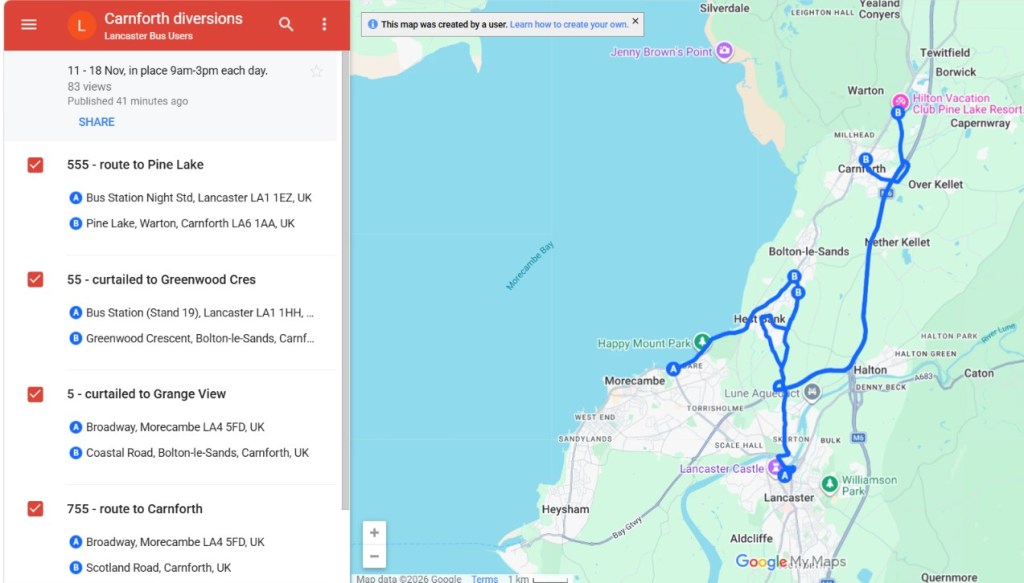
Diverted bus services during the closures For a scrollable version that you can zoom in on for detail please click this link Carnforth diversions – Google My Maps
Service 5 (Overton – Carnforth)
This service will operate only between Overton and the “Grange View” bus stop at the junction of the A6 and the Coastal Road, south of Bolton-le-Sands. There will be NO SERVICE between this point and Carnforth, Windermere Road.
Alternatives: Passengers from Heysham and Morecambe to Carnforth can use diverted service 755 (see below). Passengers between Carnforth and Windermere Road can use service 49 to/from Highfield Road.
Service 49 Lancaster – Halton – Warton
This service will be unable to stop at New Street or Carnforth station (Haws Hill) going towards Warton. Passengers for thse stops should use Market Street (Stop 6). Journeys towards Lancaster are unaffected.
Service 51 Carnforth – Silverdale
This service will start and finish at Carnforth Railway Station Car Park. Stops at the War Memorial, New Street and Haws Hill will not be served.
Service 55 (Lancaster – Carnforth)
This service will operate between Lancaster and Slyne Road only, terminating at “Townend” northbound, with southbound journeys commencing at Greenwood Crescent. There will be NO SERVICE through to Carnforth.
Alternatives: Passengers from Lancaster to Carnforth can use service 49 (see above). Passengers from Slyne Road to Carnforth can use diverted service 755.
Service 555 Lancaster – Keswick
This service will be diverted between Beaumont Bridge (Lancaster) and Carnforth (Pine Lake) via the route on the map below
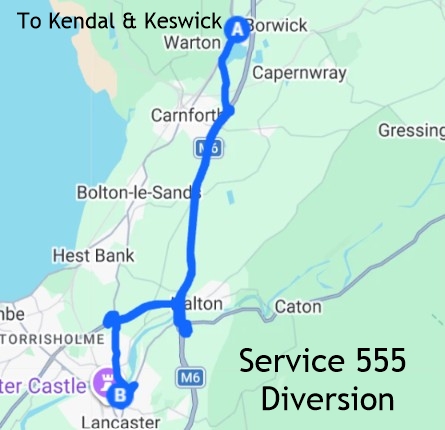
It will not serve any stops along the A6 between the A6/Bay Gateway Junction north of Beaumont and Pine Lake, including Carnforth town centre.
Alternatives: Passengers between Lancaster and Carnforth should use service 49. Passengers travelling between affected stops on the A6 between the Bay Gateway and Bolton-le-Sands Townend should use diverted service 755 (see below).
Passengers between Windermere or Kendal and Carnforth can use service 755. Other passengers from north of Carnforth should either transfer to service 755 at Kendal or travel via Lancaster and use service 49 from there.
The Bus Users’ Group has asked that service 555 continues to serve Carnforth centre by following the same route as the 755 to and from Jc 35 (see below).
Service 755 (Heysham – Bowness-on-Windermere)
This service will be diverted between “Grange View”, Jc of theCoastal Road and A6 south of Bolton-le-Sands via the route on the map below.
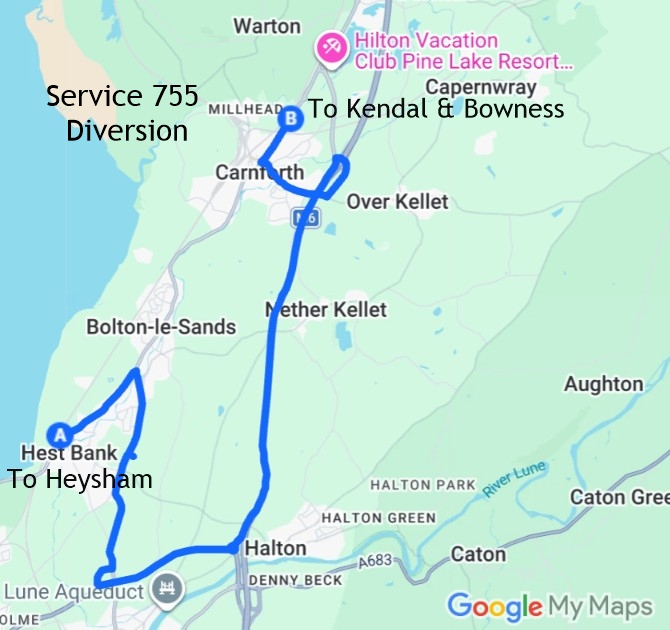
It will not serve any of the stops on A6 between St. Michaels Lane and New Street, Carnforth. In Carnforth it will stop at Market Street (Stop 6 Northbound; Stop 7 Southbound) and resume normal route via Scotland Road.
You can check the location of the bus stops in central Carnforth on this graphic
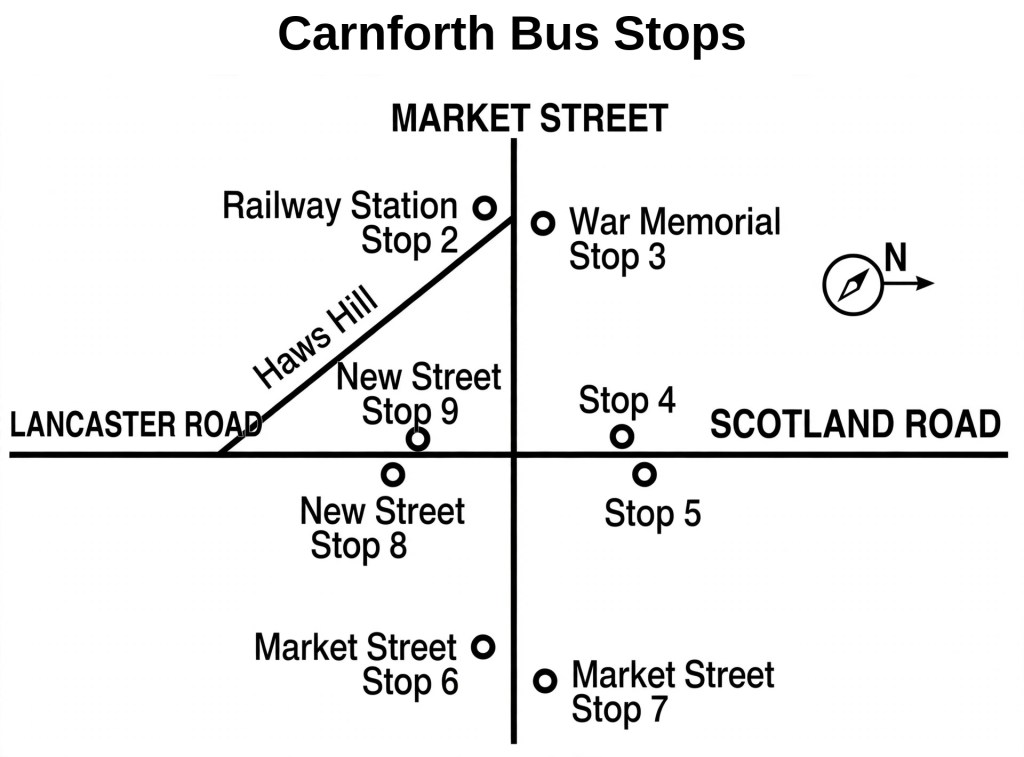
CENTRAL CARNFORTH BUS STOPS Service 49: Towards Warton – Stop 6
Towards Lancaster – Stops 3 and 7
Service 51: Towards Silverdale – Station car park (not numbered on plan)
Service 755: Towards Kendal and Bowness – Stops 6 and 5
Towards Heysham – Stops 4 and 7
NOTE: Stops 2 8 and 9 will not be served during the closure periods.
The Service Update from Stagecoach’s website is here.
Lonsdale Buses service 85 (Lancaster-Morecambe-Carnforth) will be suspended during the closures
The 1000, 1200 and 1400 hrs journeys from Lancaster to Carnforth will be CANCELLED
The 1100 and 1300 hrs journeys from Carnforth to Lancaster will be CANCELLED
Other journeys will operate as normal.
-
Council to consult on Park & Ride future.
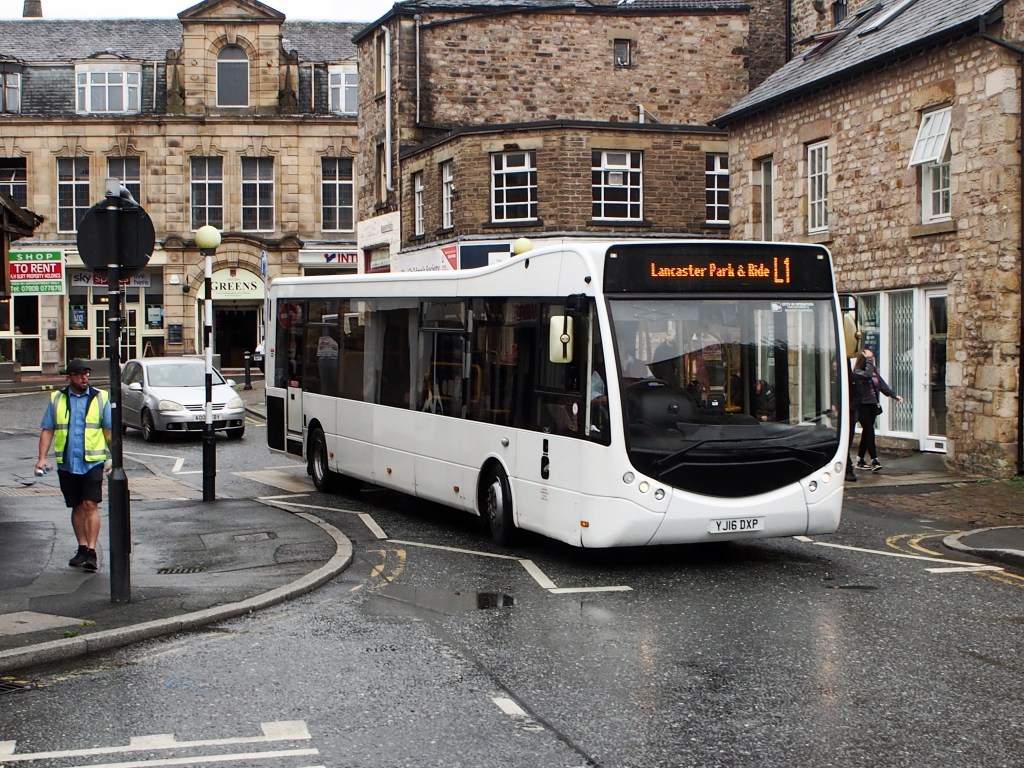
Lancashire County Council is proposing consulting the public on the future of Lancaster’s Park & Ride service, which links the car park at Junction 34 with the city centre and the Infirmary via Caton Road.
The service costs the council £780 per day (£238,000 per annum) but is used, on average, by only 150 passengers, meaning that each return passenger trip costs the council £5.20. Passengers pay just £2.50 return or nothing at all if they have a concessionary pass. Each of the 54 single trips between J34 and the Infirmary carries on average just 2.8 passengers.
Bay Gateway
The service was introduced in 2016, after the planning consent for construction of ther “Bay Gateway” (Heysham Link Road) required the provision of a dedicated car park at Jc 34 of the M6. However, no provision was made for funding to operate a bus service to the city centre. Presumably the planners assumed that bus operators would find it a commercial proposition, which they didn’t: unsurprisingly in view of the currrent figures.
Eventually, the county council came up with some money to provide a one-bus operation running every thirty minutes, this being at a time when other bus services, that people were already using, were being cut due to a lack of funding! Users of the Park & Ride do, by definition, have access to their own private transport, unlike many bus passengers.
Lack of Incentives?
There are many reasons why the service might not have reached the levels of useage needed to justify its continuance, all of which conspired to reduce the incentive for car drivers to use it. One of these was that car parking is not exactly difficult or expensive in Lancaster. Another was its low profile. At first, the service was operated by a vehicle in a dedicated promotional livery
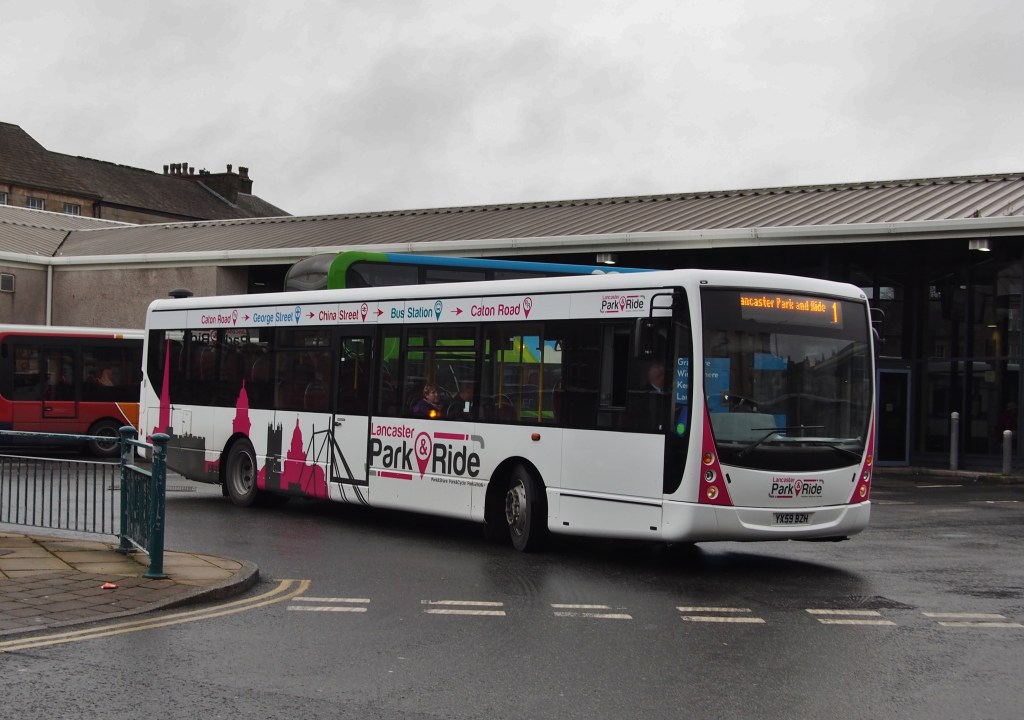
The original Park & Ride Bus but this was later discontinued and the bus operator used whatever was available from its normal fleet. The low frequency did not help, as it meant that the service wasn’t particularly visible on the city’s roads. A promotional leaflet was produced, but distribution seemed to be limited to Lancaster library and then availability was sporadic.
Frequency
The frequency was low; buses ran only every half-hour, whilst in the peaks, when demand should have been greater, it was reduced to every 45 minutes, ironically because the bus needed more time to complete its journeys due to the traffic! For a couple of years from July 2021 an extra bus was employed to increase the service to every 15 minutes, but this had the side effect of making access to the city centre by passengers more difficult (see below).
Stops
The stops in the city centre were not very convenient. To begin with, coming from Caton Road, buses called at North Road (opposite Sainsbury’s), George Street, China Street and the Bus Station of which only George Street was within the gyratory and even that was at the extremity of the shopping area. When the service was increased in fequency it was also extended beyond the centre to the Royal Lancaster Infirmary (with funding from the NHS). This added a stop at the Infirmary, but removed the stop at George Street!
Then, in July this year, when the funding was withdrawn, the frequency reverted to every 30 to 45 minutes, whilst the extension to the Infirmary remained, giving the worst of both worlds for passengers trying to access the city centre.
Local Passengers
Caton Road and the adjacent Newton Estate are not well served by local buses compared to other areas of the city, so the Park & Ride could provide a useful facility for residents. At some stage, local passengers were being catered for and there is evidence that residents of Newton Estate were walking to Caton Road to use it. Later, however, the county council withdrew this facility and insisted that the service operate “non-stop”, relenting only to allow workers and others to use the stops at the Holiday Inn and Lancaster Business Park after a campaign by employers, staff and the Bus Users’ Group.
The Future?
Assuming the Council goes ahead with its “consultation” everyone will have a chance to have their say. As a Bus Users’ Group we are conscious that the majority of people likely to be affected by closure are car owners who will have the obvious and easy alternative of driving into the city (although those at the Infirmary will admittedly have difficluties parking). Very few “bus users” will be affected.
The car park site itself is to remain open, as the council also sees it as a “park and car-share” facility whereby several car drivers can meet up and use just one vehicle to access the city (or continue down the motorway to destinations farther afield), whilst plans for Morecambe’s Eden Project envisge a Park & Ride service from Caton Road to the Eden site.
-
Fitting send-off for bus enthusiast, Christopher
Some people feel that large bus companies such as Stagecoach are focussed solely on maximising profits for their shareholders and take nothing else into consideration. But whilst it is true that profitability is important, at a local level Stagecoach can also show a more human side.
A good example of this was reported in the Lancaster Guardian, which we are pleased to reproduce below, with full permission from the family.

A much-loved bus enthusiast was given a fitting final journey when a Stagecoach double-decker travelled behind his funeral cortege as a special tribute to his passion for buses.

Christopher Wearing, bus enthusiast and regular passenger on the 6A Christopher Wearing, who tragically passed away recently, was a well-known and much-loved character in Lancaster and Morecambe and a regular customer on Stagecoach’s 6A service.
His love of buses, particularly the 6A, was well known to Stagecoach colleagues at Morecambe depot, where Christopher would often stop to chat with drivers and other members of the team. He was also a keen collector of bus timetables.
Following discussions with Christopher’s family, Stagecoach arranged for a double-decker to follow the funeral cortege from his home on September 29, travelling alongside the hearse until the route reached the Lancaster and Morecambe Crematorium lane.
The bus then travelled to the Auckland Hotel on Morecambe Promenade, where Christopher’s wake was being held, and remained there for two hours so that family and friends could take photographs and remember him alongside something that had brought him so much enjoyment.
The bus carried a portrait of Christopher as a final tribute to a customer who had made a lasting impression on the Stagecoach team.
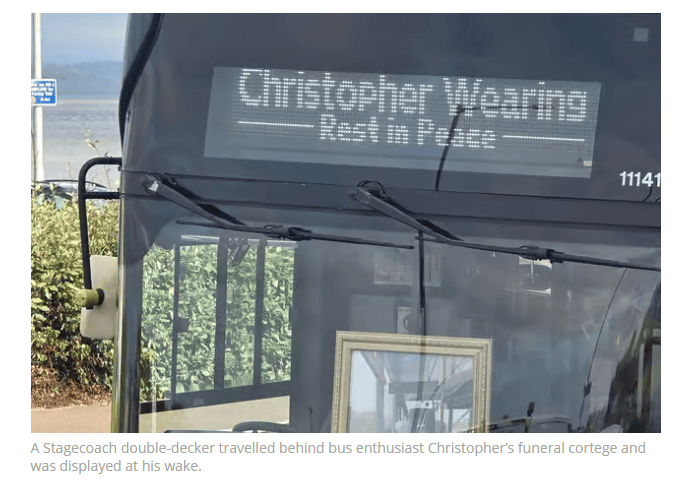
Paul Deakin, inspector at Stagecoach’s Morecambe depot, said: “Christopher was a very well-loved customer who had been travelling with us for many years. He always loved travelling on the 6A and would regularly come over for a chat with us. He also loved collecting bus timetables.
Tom Waterhouse, managing director for Stagecoach Cumbria and Lancashire, said: “We’re proud to serve the communities of Lancaster and Morecambe, and Christopher was a much-loved part of that community.
“The impact he made on our colleagues was enormous. He was an amazing individual, and providing a bus carrying his portrait was a fitting tribute to someone whose passion for buses was such an important part of his life.
“We were very pleased to be able to support Christopher’s family and friends in marking his life in such a personal way.”
-
Lancaster’s Night Buses get an Upgrade
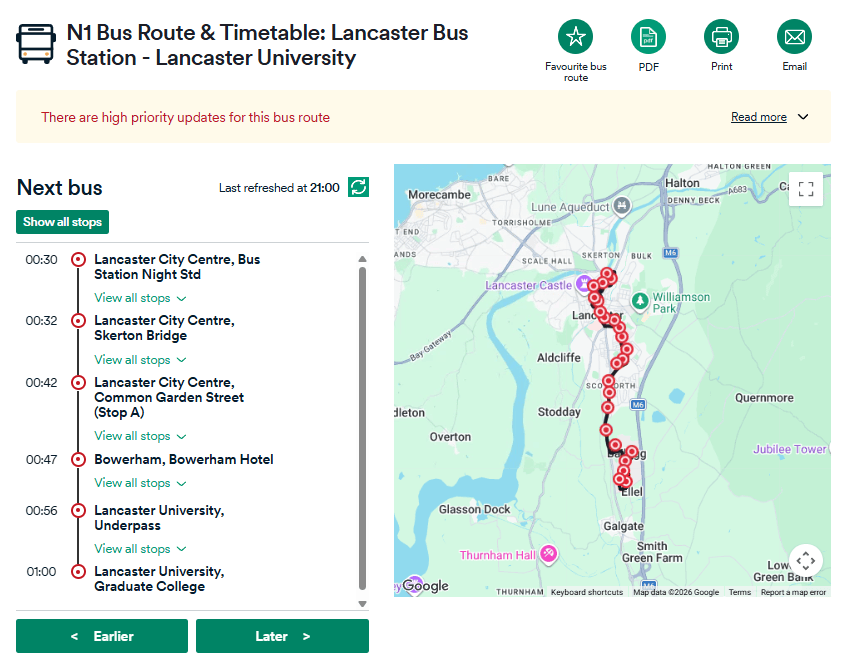
In what must be seen as a vote of confidence in Lancaster’s night-time economy, the return of university students this week brings an upgrade to the city’s only late-night bus service.
The N1, linking the city centre to Lancaster University’s campus during term time, has a new timetable from 28th September. The full early morning service now runs on four mornings a week (Thursdays to Sundays) with Tuesdays and Wednesdays seeing a single trip in each each direction.
Route extended
The route of the service has been extended in the city to take in stops at Parliament Street, St. Leonards Gate and opposite Sainsbury’s to cater for passengers from the Sugarhouse and Kanteena night-time venues, whilst on campus it now extends beyond the Underpass to the Graduate College to bring sgtudents closer to the residential areas of the university.
Extra resources
The new service requires an extra vehicle and driver and represents a significant investment by Stagecoach in the service, although the cost of this is mitigated somewhat by the cancellation of the free “Sugarbus” service that the Students Union commissioned from Stagecoach twice a week. Unlike the Sugarbus however, the N1 caters for all passengers and is not resricted either to students or patrons of any particular establishment in the city.
Late night/early morning bus services are very rare outside major cities and extremely so in towns and cities the size of Lancaster and the city is fortunate to be able to benefit from this one.
-
Changes to stands at Lancaster Bus Station
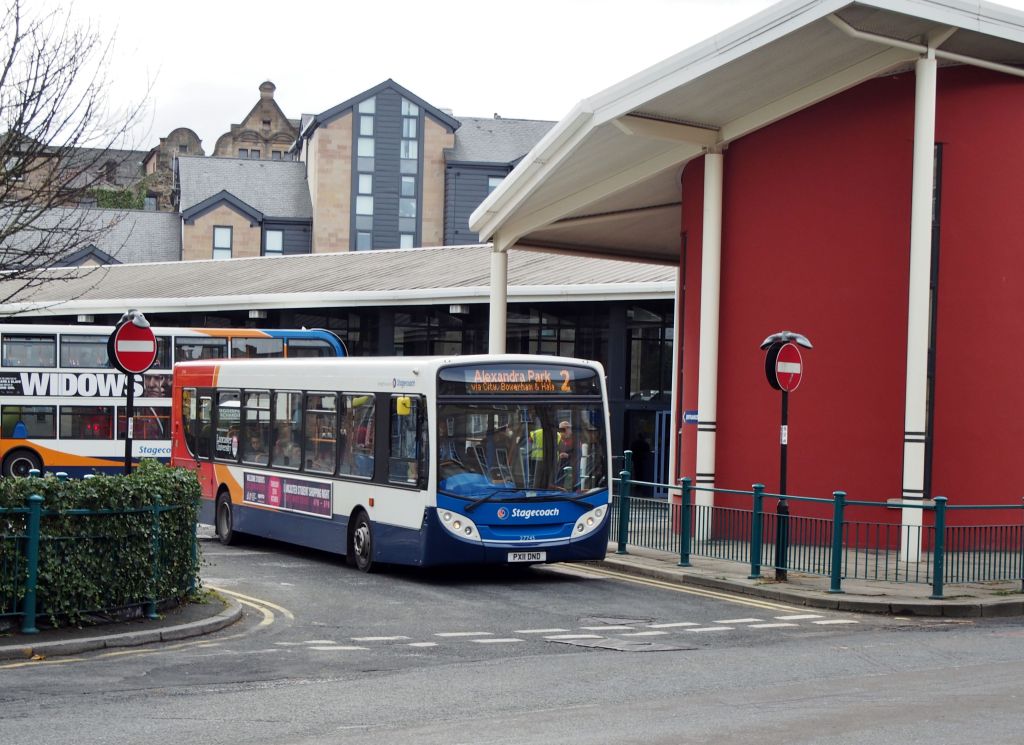
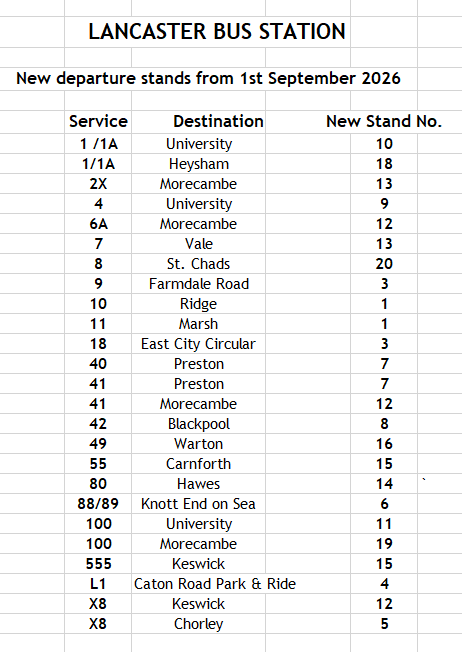
Buses will leave from different stands in the bus station from 1st September In an attempt to “reduce congestion” and to try and get more buses to actually leave from the correct place, there will be changes to departure stands in the bus station from Tueaday, 1st September.
Here are the new stands:
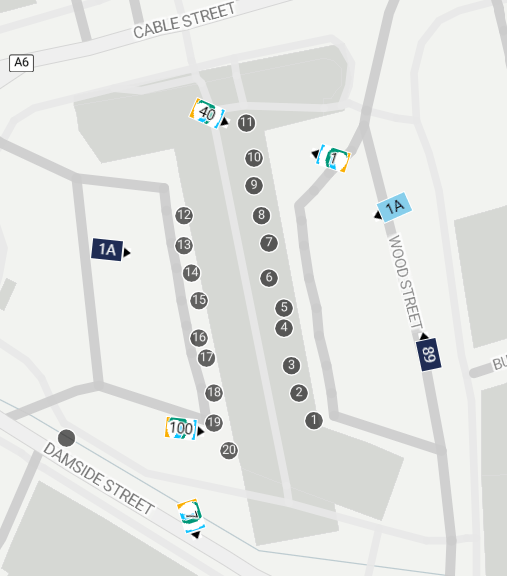
Map of Lancaster Bus Station showing location of numbered stands The Bus Users’ Group hopes this move will be succesful in reducing the number of buses that leave from the wrong stand, although whilst stand 17 is out of action awaiting the long-delayed repair to the road surface it won’t make things any easier for drivers and passengers alike.
-
Students hit with bus pass price hike

Whilst Stagecoach’s fares increase earlier this month was very modest (and, of course, constrained by the £3 fares cap) one group of passengers will see a much larger rise in travel costs.
Students at Lancaster University are complaining about what appears to be a huge increase in the price of Unirider tickets, compounded by the withdrawal of one of its most popular versions.
Unirider tickets offer unlimited travel in the Bay Megarider area but are only sold to students. With Lancaster University’s campus being 5km south of the city centre and with large numbers of students living in the city, buses are a popular method of transport, with fourteen buses an hour running between the two in term time and more at peak times.
Increase

In previous years, Uniriders came in three versions: A one-term ticket; a three-term ticket covering the academic year but not the vacations and an annual pass that gave a full twelve-months travel. In 2025/6 the three-term ticket cost £389, increased from £360 the year before. The Annual ticket was priced at £499. However, for the forthcoming academic year the three-term ticket is not offered, leaving students with a choice of a One Term Ticket at £174 (three of which would cost £522 but exclude vacations) or the annual ticket at the new price of £555.
Whilst the price of the annual ticket itself has risen by 11% (at a time of 3% inflation), students who would have bought the Three Terms ticket at £389 are faced with a hike of 34% if they choose three one-term tickets (excluding vacations) or 42.6% if they opt for the Annual at £555.
Simplification
Stragecoach’s Managing Director, Tom Warterhouse, defended the increase, saying that the range of tickets had been “restructured” and “simplified” for the coming academic year.
He told the Bus Users’ Group: “The Term ticket still offers incredible value for money at £2.32 unlimited travel per day and the annual at £1.54 per day. As with the previous £2 capped fare, students can choose whichever duration of ticket they wish, but our UniRider range of products still offers much better value for the large number of students making regular journeys.
Alternatives
Despite the increases, the Unirider still appears to offer savings over the alternatives, which are all that is on offer to other passengers:
Single Tickets: Stagecoach’s response (above) quotes costs that appear to be based on 75 days travel for the termly ticket and 360 days for the annual. The single fare between the Campus and the City Centre is £2.20, forecast to reduce to £2 from January. Assuming two single journeys per day, 75 days travel would cost £330 in term one and £300 in terms two and three, a total of £930 for the year (excluding vacations).
Day Rider Tickets At £6.20, a Day Rider ticket is only worth buying if more than three single journeys are made in any one day. When fares are capped at £2, four single journeys per day will be necessary before a saving is made.
Weekly and Monthly Tickets: Alternatively, Eleven 7-day tickets at £23 would cost £253 per term (£759 per year) or 3 x 28 day tickets at £74 each would work out at £242 for a term (£726 per year) in both cases excluding vacations.
The Unirider ticket, even at its new, higher, price still appears to be significantly cheaper than the alternatives.
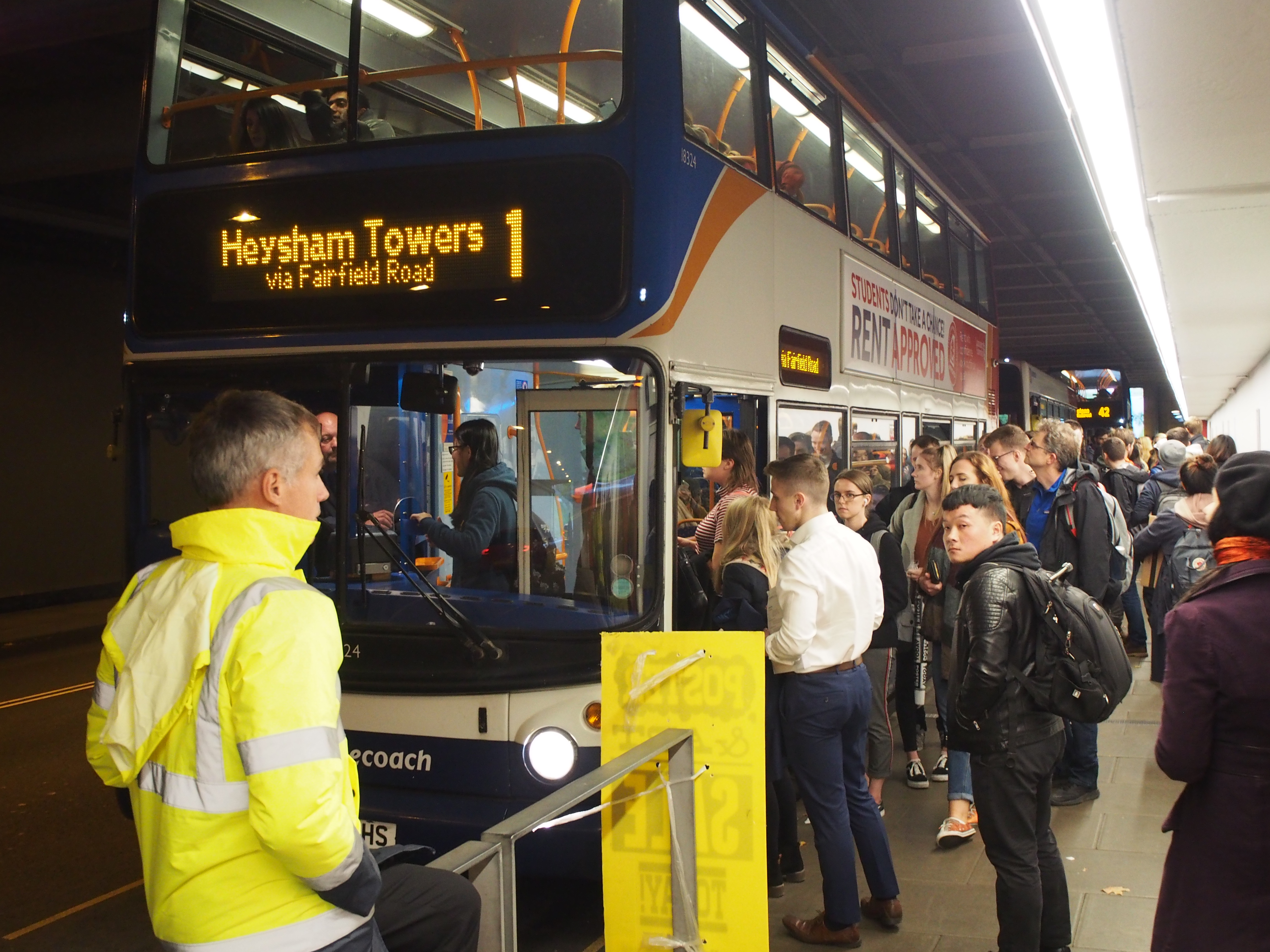
Students are good business for Stagecoach
Law of Unintended Consequences?
Although under our deregulated bus system operators have complete commercial freedom when it comes to fares, in practice recent years have seen them constrained by a number of government initiatives. The most prominent of these is the fares cap, which has seen fares capped at £2 (2023-2025); £3 (2025-2026) and now £2 for 2027. Although the cap applies only to adult single fares, in practice it has limited the extent to which daily, weekly or monthly ticket prices can be increased before they become more expensive than singles for regular travellers.
Whilst the governemt compensates bus companies for the loss of income, the amounts paid are apparently non-negotiable and dependent on what theDepartment for Transport thinks is appropriate. Some bus companies have been disatisfied with the compensation on offer and have not participated in the scheme, which is volunatry.
With most fares effectively capped, and costs such as fuel continuing to rise, it wouldn’t be surprising if bus operators were looking for ways to increase revenue from those tickets that are not affected by the cap. By the end of 2027, single fares will have been capped for five years and the cap could, of course, be extended, putting more prerssure on bus operators to look for other ways of increasing revenue in future.
-
Free travel all day for Disabled Pass holders
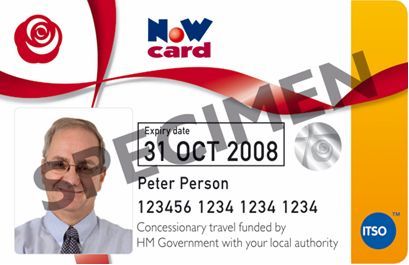
In another policy statement on buses, Andy Burnham’s government has announced that the restrictions on the use of concessionary bus passes issued to disabled people are being lifted.
A government spokesman said:
“Eligible disabled people across England will get free bus travel all day, every day, after the Prime Minister announced today (Tuesday 18 August) that the government will lift time restrictions on concessionary passes.
From 1 April 2027, people who hold a disabled bus pass can travel on buses for free, no matter the time of day. This extra support will help to open up access to workplaces, education, training, and other opportunities as well as giving people breathing space on the cost of living and putting money back in people’s pockets.
Currently, disabled bus passes are only valid for travel between 9.30am and 11pm during weekdays, unless local authorities choose to fund an extension. For example, Greater Manchester Combined Authority permanently lifted the time restrictions from March this year.
Backed by £60 million of funding, the Government is now stepping in to remove these time restrictions across the whole of England, so that from next year, disabled bus pass holders can always travel for free on the most popular form of public transport, regardless of their postcode.”
The change is the latest development to affect disabled pass holders in Lancashire. Prior to December 2018, pass holders could travel before 0930 on payment of a flat fae of 50p. In December 2018, citing budget pressures, this was raised to £1, which applied until April 2025 when the facility was abolished altogether and pass holders couldn’t use their pass until 0930hrs.
Anomalies?
Although the headlines surrounding the announcement stress the ability to travel free in the morning peak, the small print makes it clear that the evening travel restriction is alo being lifted. This leads to the seemingly annomalous position that holders of Disabled passes can travel after 23.00hrs but holders of Senior Citizens’ cards have to pay full fare.
Time for a review?
Whilst there are good grounds for allowing disabled passholders to travel free in the morning peak and whilst there is a need to prevent overloading of busy buses taking people to work and school by passengers riding for nothing, the Bus Users’ Group feels that it is time the 0930 start time was at least reviewed. Outside London and a few larger cities, the peak demand for bus travel is by schoolchildren rather than workers and most children are in school well before 0900. Bringing the start time forward by half-an-hour would give greater flexibility to pass holders and, by spreading journey start times over a longer period, reduce the pressure from passholders on the first bus that comes along after half-past-nine.
Evenings
At present, bus passes cannot be used after 2300 hrs on Monday to Friday nights. The Bus Users’ Group has never seen a credible justification for this other than that it is “national policy”. Lancaster has a better late evening bus service than many places its size with buses running after 2300 to Morecambe, Bare, Heysham, Galgate, Garstang, Bowerham and the University. Despite being well used, they are rarely full and certainly have room for a few passholding pensioners who, contrary to belief, do enjoy an occasional night out! That the restriction was never thought through is clear in that it doesn’t apply on Saturday nights, or after midnight on Fridays, the two busiest nights of the week!
From 1st April 2027 these late night buses will be free for holders of disabled passes, and whilst senior citizens will not begrudge them this “perk” they will be wondering just why it doesn’t apply to them too.
-
Stagecoach changes its timetables
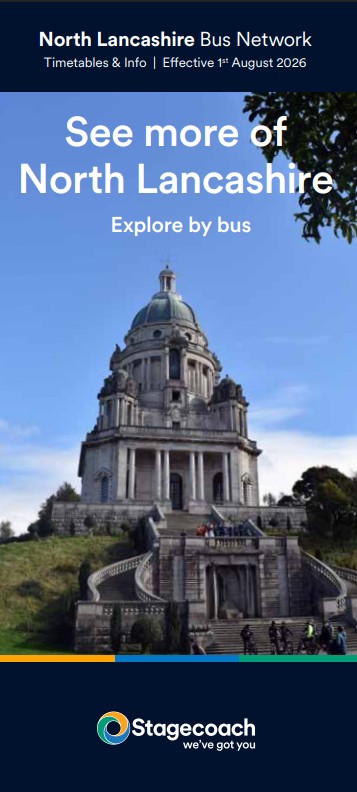
Stagecoach has changed the way it publishes its printed timetables for Lancaster and Morecambe, bringing them into line with other parts of the network. A new 69-page booklet, in a similar style to the popular “Lakes by Bus” publication, includes (almost) every Lancaster and Morecambe-based service and replaces a whole series of individual service leaflets.
Design
The Guide contains a network map, unfortunately not to the same high cartograpic standard as that in the Lakes Guide, but nevetheless adequate; a list of the bus services contained and a three-stage “How to Catch the Bus” section. Presumably aimed at those new to bus travel, or considering in for the first time, this takes readers through the process of planning a journey and buying a ticket. The third stage, however, entitled “Go”, advises passengers to “Wave the bus down and enjoy the journey”. New users – or those from other parts of the world where bus travel is less formal – could be forgiven for not realising that the “waving down” has to be done at a recognised bus stop!
Also included are some ideas for days out on the bus to local attractions and details (but not prices) of tickets. (A QR code link is provided for these).
Timetables
The timetables themselves follow the standard Stagecoach pattern in a clear and easy-to-read format, although those with poor colour vision might struggle to understand the purpose of the various shadings applied to some journeys. One fault concerns services 1/1A, 4 and 100 that serve Lancaster University and have significantly different service levels in term time and holidays. Both levels of service are shown, but unlike some previous leaflets there is no information on when “term time” and “holidays” actually are. Instead, passengers are asked: “For Lancaster University term dates, please check their website”(sic). It wouldn’t have been difficult to provide an actualwebsite adress, the Bus Users’ Group can do it on our website after all. In practice, there is plenty of room in the booklet to provide the actual dates for the whole of the forthcoming academic year and these are known well in advance.
Only Stagecoach services are included as the “Enhanced Partnership of Operators and Councils” doesn’t appear to extend to comprehensive timetables yet. On the two services where Stagecoach provides part of the timetable and Lonsdale Buses the remainder – the 18 and 81 – only Stagecoach journeys are shown and passengers are just informed that the other operator provides the rest, again with no website address or other means of establishing the full timetable.
Unfortunately, unlike recent leaflets, it appears that there is no room for the Bus Users’ Group logo in the new publucation.
Dates of Operation
The cover carries the apparently arbitrary date of 1st August (no timetables actually changed on this date), although the timetable for service 55 doesn’t apply until 30th August, when minor changes will be introduced. Unlike the Lakes Guide, there is no end date to validity. This is a common problem with bus timetables and produces unceratinty over accuracy as time goes on. The Group hopes that Stagecoach will resist the temptation to make minor changes, or at least to save them up and combine them with sufficiently large revsions that justify re-issuing the whole Guide. Better still would be to submit to the discipline of a published “until” date and delay any chnages until then, so that passengers know where they stand. This has been practice in the Lakes Guide for several years and hasn’t prevented the introduction of additional services during the validity period.
Missing Links
The 555 and 755 timetables can only be found in the Lakes Guide Two important services are missing from the Guide. The 555 Lancaster to Kendal and 755 Heysham to Bowness have only QR codes that enable suitably-equipped passenegrs to read the timetables on their smartphones. For print copies it is necessary to obtain a copy of the Lakes Guide.
Omitting these services saves just five pages of print (out of 69) and the current timetables for these services run until 1st November, by which time Stagecoach is more than lilely to want to make changes to Lancaster services anyway. The Group feels that they should be included.
The booklet is available from Lancaster Bus Station and it is promised that copies will also be available on the buses, although we have yet to see one.
Despite these minor “niggles” the Bus Users’ Group recognises and supports Stagecoach’s commitment to printed timetables and the fact that putting (almost) everything in one booklet makes it much easier for passengers to get the full picture of the services available to them. Who knows, it might even encorage people to make additional bus journeys to places that they didn’t even know they could get to!
-
Fares Up. . . And Fares Down!

Bus fares are changing in August, but not all in the same direction – and there will be further ups and downs to come in the next few months.
Free Child Tickets in August
Both our local operators, Stagecoach and Lonsdale Buses, will be participating in the government’s “Great British Summer Savings” scheme that sees children aged 15 and under travelling completely free on local buses for the whole month of August.
Once you have delved deeply enough into the website to find the announcement, here is what Stagecoach says about it: “Free travel is available on most local bus journeys in England between 1 and 31 August 2026 for children aged 5–15 inclusive. However, some services are not included in the scheme, including certain longer-distance coach services, routes where older and disabled persons’ concessionary travel is not available, and dedicated school bus services.” The Bus Users’ Group understands that the only service likely to be included in the list of exceptions, where free child travel will not apply, is service X8, the Saturday-only limited stop service that calls at Lancaster Bus Station en-route from Chorley to Keswick.
Lonsdale Buses does not mention the scheme on its website at the time of writing, but it has confirmed to us that it will be part of the scheme.
There is nothing to say that children have to be accompanied by a fare-paying adult, nor do they need a pass or special ticket to take advantgage of the offer. Older children, however, might want to carry some sort of proof of age, especially if they look older than they are.
Stagecoach Fares up on 5th August
Four days after children become eligible for free travel, the cost for some adult passengers is going up as Stagecoach revises fares.
With effect from Wednesday 5th August, some Stagecoach bus fares are changing across “Cumbria” & Lancashire. Most passengers will not see a change to the fare which they pay, with the maximum price of a single ticket remaining at £3 and some other tickets, such as 28 day and Xtra products, remaining frozen in price.
Full details are on this link: but basically, some fares under £3 will rise by 10p; A Bay Area Day Rider will increase by 20p to £6.20, a Lancashire Day Rider goes up by £1 to £11 and a North West Explorer rises by 50p to £12.50 with a seven day Mega Rider going up from £22 to £23. The maximum price of a single journey will remain capped at £3.
All Fares Reduced from January
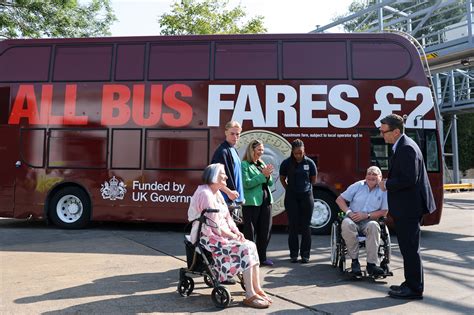
Assuming that our local operators agree to participate in the recently-announced £2 Fare Cap Scheme, these increases, at least to single fares, will be short-lived. Any fare under £3 that is increased by 10p from 5th August, will automatically reduce to £2 from January! Existing £3 single fares will also be reduced to £2 for the whole of 2027.
Stagecoach may also not get the hoped-for benefit from the increased price of Day Tickets. At £6.20 the Day Rider will be bought by anyone making more than two “capped” journeys at £3 each, but with the cap at £2 it will need more than three such journeys before a Day Rider becoames the best option. A North-West Explorer at £12.50 will only become a viable option if seven or more journeys are made in one day, making it attractive only to the most dedicated of bus riders.
Lonsdale Buses, assuming it joins the scheme, may want to think about the price of its £15 day ticket – requiring no fewer than 8 journeys in a day to break even against capped single fares.
Neither Up nor Down
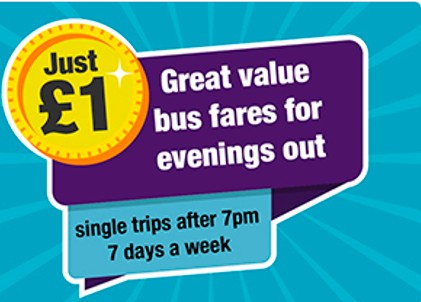
And where does all this leave Lancashire County Council’s £1 Evening & Sunday fare cap? These fares won’t be affected by the August increase, but are due to rise to £2 in September. However, in January ALL bus fares are to be capped at £2 (assuming operators participate), which will be government-funded and if the government is paying to cap all fares at £2, presumably Lancashire will not need to pay for them to be capped at all. This could and perhaps should mean that the £1 cap will be reinstated or, better still, not raised from September in the first place.
We will keep you posted.
JOIN US
Membership is open everyone and the subscription is £5 per annum (£2 for Bus Pass holders and students).
You can join either by
- Sending a cheque made payable to Lancaster Bus Users Group to Steve Clarke, 75 Spruce Avenue, Lancaster LA1 5UB together with your full name and contact details
- E-mailing office@lancasterbususers.com and asking for details of how to pay us directly by bank transfer
- Coming along to one of our meetings and paying there by cash or cheque.
- Meeting dates are shown on the left hand sidebar of this site.

